
The International Program of Natiometric Observatories (ONM)
Towards a Global Infrastructure for Civilizational Intelligence
Introduction:
The world entering a new era of uncertainty
The 21st century opens a period of profound transformation in global balances. Geopolitical tensions, recurring economic crises, accelerated technological shifts, and the fragmentation of information flows are reshaping the dynamics of contemporary societies. In this context, nations evolve at an increasingly rapid pace, driven by the combined influence of political, economic, cultural, and technological factors.
Faced with this growing complexity, traditional analytical tools—whether political, economic, or sociological—show their limits. They often allow observation of events after they occur but struggle to anticipate the deep transformations affecting societies.
In a world marked by strategic uncertainty and the multiplication of systemic crises, understanding national trajectories becomes a central challenge. It is precisely to meet this need that a new approach emerges: Natiometry.
1 — Natiometry: A New Science of National Dynamics
Natiometry proposes to study nations as evolving complex systems, whose transformations result from interactions across multiple dimensions: historical, political, economic, cultural, and technological.
This approach is based on a systemic vision of the nation. Rather than analyzing separately the various domains of collective life, Natiometry seeks to understand their dynamic interactions and the deep structures organizing societal evolution.
It mobilizes tools from multiple disciplines:
-
History and the analysis of civilizational cycles
-
Political science and sociology
-
Economics and geopolitics
-
Mathematical modeling and systemic analysis
Within this framework, Natiometry relies on innovative conceptual and analytical instruments, including:
-
The Natiometer, a tool for analyzing national dynamics
-
The study of civilizational cycles
-
The use of a national phase space
-
The construction of dynamic indicators of societal transformation
The ambition of this discipline is to transform the study of nations into an analytical science capable of producing observation, measurement, and forecasting instruments.
2 — The International Program of Natiometric Observatories (ONM)
To translate these scientific principles into an operational system, the International Program of Natiometric Observatories (ONM) was designed.
The program aims to establish a global network for observing and analyzing national dynamics. Its goal is to structure a permanent system for collecting, analyzing, and interpreting data on contemporary societal transformations.
The ONM network will be tasked with:
-
Collecting multidimensional data on societies
-
Analyzing political, economic, and cultural dynamics
-
Identifying early signals of deep transformations
-
Producing civilization-level indicators comparable internationally
Ultimately, the program aspires to create a true global infrastructure for strategic intelligence dedicated to the study of nations.
3 — A Three-Tiered Network Architecture
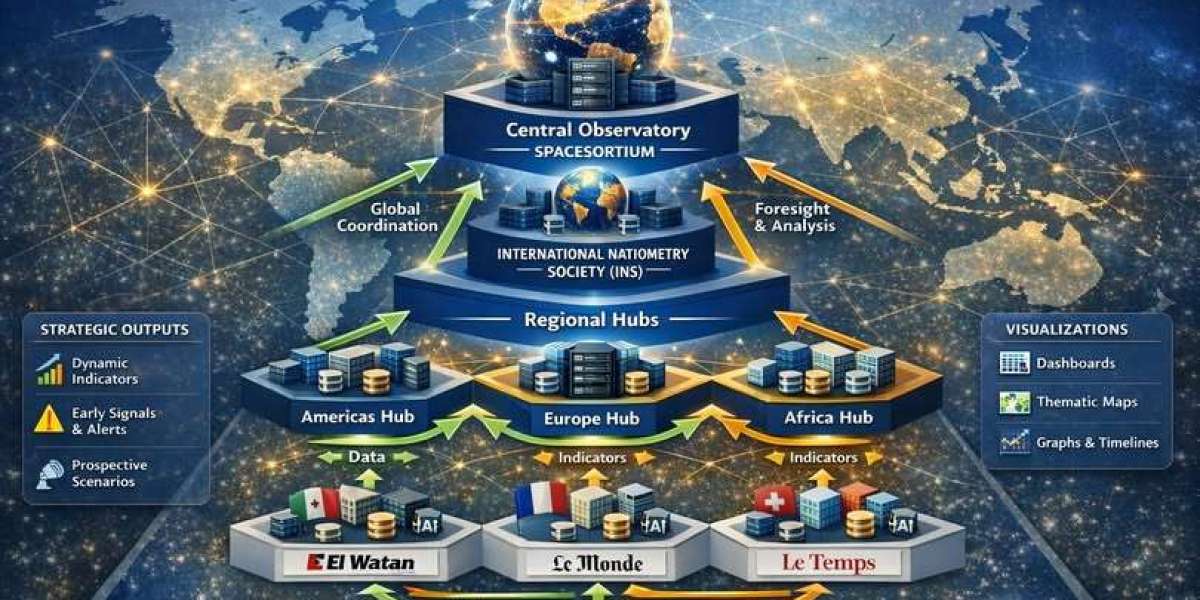
The ONM program is built on a three-tier organizational structure, enabling integration of local, regional, and global analyses.
National Observatories
At the foundation are the National Natiometric Observatories, responsible for direct observation of dynamics within each society.
Their duties include:
-
Collecting social, economic, and political data
-
Analyzing institutional and cultural transformations
-
Identifying emerging trends and early warning signals
These observatories constitute the primary information source for the global system.
Regional Hubs
National observatories are grouped within regional hubs, which analyze dynamics across large geopolitical areas.
These hubs function to:
-
Compare national trajectories
-
Identify regional trends
-
Analyze interactions between political and economic systems within a region
They play a key role in understanding convergence and divergence phenomena among nations.
Central Observatory
At the top of this structure is the Central Observatory, responsible for scientific and technological coordination across the network.
This observatory relies on two key institutions:
-
SPACESORTIUM, responsible for technological infrastructure and analytical platforms
-
The International Natiometry Society (INS), ensuring scientific and methodological guidance
The Central Observatory ensures:
-
Global synthesis of collected data
-
Modeling of civilizational dynamics
-
Production of long-term prospective scenarios
4 — The Strategic Role of International Media
The establishment of such an observation network cannot be limited to academic or technological institutions. It also requires the involvement of actors capable of capturing and disseminating information globally.
In this context, the international press can play a decisive role.
Reference newspapers such as El Watan, Le Monde, and Le Temps possess unique expertise in the daily observation of political, social, and cultural transformations.
Their participation in such an initiative could establish an international media consortium dedicated to observing civilizational dynamics.
Such a partnership would offer several advantages:
-
Enrich scientific analyses with journalistic expertise
-
Strengthen dissemination of ONM network findings to the public
-
Reconnect journalism with strategic foresight
In an information environment dominated by rapid digital networks, this collaboration could also reinforce the role of professional journalism as a central actor in understanding the contemporary world.
5 — A New Generation of Civilizational Indicators
A major objective of the ONM network is the production of a new category of analytical tools: dynamic civilizational indicators.
These indicators would allow for:
-
Identifying phases of societal transformation
-
Detecting early signals of crises or mutations
-
Mapping the trajectories of nations
-
Developing prospective scenarios on political and social system evolution
Ultimately, these instruments could play a role in analyzing nations comparable to climate observatories for the environment or monetary institutions for economic regulation.
They would help societies better understand and anticipate their own transformations.
Conclusion :
Towards a Global Intelligence on Nations
The 21st century is likely to be marked by intensified interactions among human societies. In a globalized world, the transformations of a single nation can have repercussions far beyond its borders.
In this context, establishing a global infrastructure dedicated to observing national dynamics is a major scientific and strategic challenge.
The International Program of Natiometric Observatories seeks to address this challenge by creating a framework for intellectual and institutional cooperation to better understand the profound evolutions of human societies.
Its ambition is simple but essential: to contribute to the construction of a global intelligence on nations, capable of guiding collective choices and supporting transformations in the contemporary world.
Understanding nations—their trajectories and evolutionary cycles—remains one of the fundamental conditions for shaping the future of humanity.
The world has observatories for climate, economy, and health.
Perhaps it is time to also create a global observatory for civilizational dynamics.