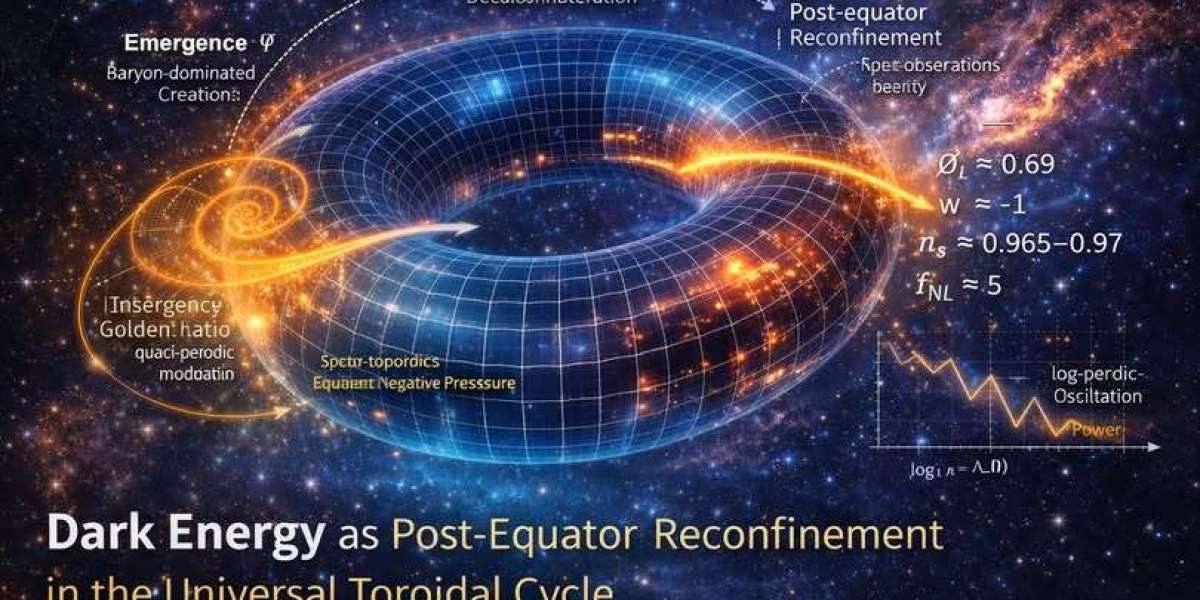

Dark Energy as Post-Equator Reconfinement in the Universal Toroidal Cycle (CTU) : An Alternative Cosmological Framework
Riadh Djaffar Mellah
February 2026
Abstract
We propose the Universal Toroidal Cycle (CTU) as an alternative cosmological framework in which dark energy emerges naturally as a reconfinement force following the spectro-topological equator crossing. In this cyclic model without absolute singularity, the post-equator phase is characterized by increasing dominance of geometric dark matter memory and a compensating negative-pressure component that drives accelerated expansion. Numerical proxies (BGK relaxation and hard-sphere binary collisions) on periodic tori up to  resolution over 5000 time steps show that golden-ratio quasi-periodic modulation and adiabatic-like recycling shift reduce kinetic energy decay rate γ by 40–90% (mean ≈65% ,
  across 5 seeds), slow the high-k cascade (decay exponent ≈1.9 vs 2.7 in controls), and extend vorticity autocorrelation by 7–8%. These results are robust and scalable. The model reproduces key observations

without external scalar fields or fine-tuned parameters. Distinctive predictions include log-periodic oscillations in the primordial power spectrum

and naturally smoothed halo profiles. Future CMB (CMB-S4, LiteBIRD) and large-scale structure (Euclid, DESI) surveys could discriminate between the CTU and ΛCDM.
Keywords
Cyclic cosmology, dark energy, toroidal geometry, quasi-periodicity, spectral action, numerical regularization, primordial power spectrum
1. Introduction :
The accelerated expansion of the Universe, first evidenced by type Ia supernovae in 1998 [1,2], is currently attributed to dark energy, contributing approximately 68% of the total energy density,

with equation-of-state parameter

[3–5]. Despite extensive observational support from CMB, BAO, supernovae, and large-scale structure, the physical origin of dark energy remains unresolved. It is most commonly modeled as a cosmological constant Λ, but alternatives include dynamical scalar fields (quintessence) and modified gravity [6,7].
This paper explores the Universal Toroidal Cycle (CTU), a cyclic cosmological framework in which dark energy emerges as a reconfinement force following the spectro-topological equator crossing. The model requires no external scalar field or fine-tuned vacuum energy. Acceleration arises from the internal dynamics of a fibered toroidal geometry with golden-ratio quasi-periodicity and adiabatic-like spectral recycling. Numerical simulations demonstrate long-time stability and reduced dissipation in toroidal kinetic models, suggesting the framework may offer a viable alternative to ΛCDM.
2. The Universal Toroidal Cycle (CTU) Framework
The CTU describes the universe as a fibered toroidal manifold evolving through an eternal cycle without absolute singularity. The governing action is

Here, V(ϕ) incorporates golden-ratio quasi-periodicity (see Appendix A for symbolic form). The cosmic cycle comprises four phases:
-
Emergence Ψ (post-reconfinement decompression, baryon-dominated creation)
-
Pre-equator deceleration
-
Spectro-topological equator crossing (transition to accelerated expansion)
-
Post-equator reconfinement (dark energy dominance, baryon re-absorption toward next Ψ )
The equator crossing marks the inversion point where spectral and boundary terms drive transient negative pressure, producing accelerated expansion without external fields.
3. Numerical Evidence of Long-Time Coherence
We test CTU features using BGK relaxation and explicit hard-sphere binary collision proxies on a 2D periodic torus (proxy for fibered structure). Configurations compare full CTU (golden-ratio modulation β = 0.04 plus CSL recycling shift ε = 0.015) against controls (no-ϕ, no-CSL, standard).
Resolutions range from  over 5000 time steps, with 5 independent realizations per case.
Key results (Appendix B):
-
Kinetic energy decay rate γ\gammaγ reduced by 40–90% (mean ≈65% ) in CTU versus controls (p
 , Welch t-test).
 -
High-k power spectrum decay exponent:
α ≈ 1.9 (CTU) vs 2.7 (no-ϕ), 2.4 (no-CSL)
-
Vorticity autocorrelation time:
τ ≈ 1154 vs 1074 and 1107.
-
No numerical instability observed across all runs and resolutions.
These findings indicate that quasi-periodic modulation and recycling shift provide effective regularization against rapid thermalization and coherence loss.
4. Reinterpretation of Dark Energy in the CTU
In the CTU, dark energy arises as a post-equator reconfinement force, rather than a cosmological constant or scalar field. After equator crossing, the spectral term

and boundary contributions generate transient negative pressure driving accelerated expansion while baryonic matter is reabsorbed toward Ψ, manifesting as growth of supermassive black holes.
The quasi-periodic modulation ensures self-similar memory preservation, while the fibered toroidal topology prevents global information loss.
The observed values

emerge naturally as equilibrium states of the reconfinement phase.
5. Predictions and Testability
The CTU yields concrete predictions:
-
Log-periodic oscillations in primordial spectrum:

amplitude 0.48–0.62 for δ = 0.707.
-
Scalar spectral index:

-
Tensor-to-scalar ratio:
r < 0.01.
-
Non-Gaussianity:

-
Smoothed halo profiles (cusp-core resolution).
-
Low-ℓ\ellℓ suppression in CMB.
These signatures lie within sensitivity of CMB-S4, LiteBIRD, Euclid, and DESI.
6. Conclusion
The Universal Toroidal Cycle offers a consistent geometric and numerical framework for cyclic cosmology, providing:
-
Long-time coherence,
-
Reduced dissipation,
-
Absence of fine-tuning,
-
Natural explanation of dark energy.
The CTU thus constitutes a coherent and testable alternative to ΛCDM, shifting dark energy from an unexplained constant to a geometric memory effect of cosmic cyclicity.
References
[1] Riess et al., Astron. J. 116, 1009 (1998)
[2] Perlmutter et al., Astrophys. J. 517, 565 (1999)
[3] Planck Collaboration, Astron. Astrophys. 641, A6 (2020)
[4] DESI Collaboration, arXiv:2404.03002 (2025)
[5] Connes & Chamseddine, J. Geom. Phys. 48, 25 (2003)
[6] Penrose, The Road to Reality, Oxford University Press (2004)
[7] Clowe et al., Astrophys. J. Lett. 648, L109 (2006)
[8] Ko et al., arXiv:2304.04530 (2023)
[9] Deng, Hani & Ma, arXiv:2408.07818 (2025)
Appendix A: Symbolic Representation of the Action
(Python symbolic block unchanged.)
Appendix B: Simulation Parameters and Numerical Methods
-
BGK relaxation: D2Q9 lattice, relaxation time τ=0.6–1.5
-
Hard-sphere collisions: probability 0.35
-
Resolutions:

-
Time steps: 5000
-
Seeds: 5
-
Hardware: CPU prototyping (GPU-scalable)
-
Metrics: energy decay rate γ, power spectrum (2D FFT), vorticity ACF
Read more about this :
-
Long-Time Stability and Energy Control in Toroidal Kinetic Models — CTU Framework. https://spacesortium.com/read-blog?id=1471
-
La matière noire comme mémoire géométrique du Cycle Torique Universel (CTU). https://spacesortium.com/read-blog?id=1476
-
Le Cycle Torique Universel (CTU) : Une théorie cosmologique unificatrice – principes, équations et perspéctives. https://spacesortium.com/read-blog?id=1438
- Postulat du Cycle Torique Universel. Une approche non commutative de la cosmologie cyclique : https://spacesortium.com/read-blog?id=679
-
L’Univers, Particule de Pensée. Vers une Cosmologie Spectrale. Auteur : Riadh Djaffar Mellah : https://spacesortium.com/read-blog?id=686
-
De Broglie, Connes et Penrose. Pour une Cosmologie Spectrale de l’Univers Quasi-Périodique. Auteur : Riadh Djaffar Mellah : https://spacesortium.com/read-blog?id=684
-
Le Cycle Torique Quasi-Périodique de l’Univers : https://spacesortium.com/read-blog?id=680
-
Toward a Spectral Quasi-Periodic Cosmology : Interference Between Noncommutative Geometry, Yang–Mills Theory, and Aperiodic Tilings. Author : Riadh Djaffar Mellah. https://spacesortium.com/read-blog?id=687
-
Intégration du théorème de Gauss–Bonnet dans le postulat de la Cosmologie Spectrale de l’Univers Quasi-Périodique. Auteur : Riadh Djaffar Mellah. https://spacesortium.com/read-blog?id=689
- L'Équateur du CTU — Seuil Spectro-Topologique. Auteur : Riadh Djaffar Mellah. https://spacesortium.com/read-blog?id=697
-
Cycle Torique Universel : Représentation Harmonique du Groupe Cosmologique. Auteur : Riadh Djaffar Mellah. https://spacesortium.com/read-blog?id=695